Understanding the Evolution of CAUSE II Component 1 Subprojects: From Planning to Groundbreaking
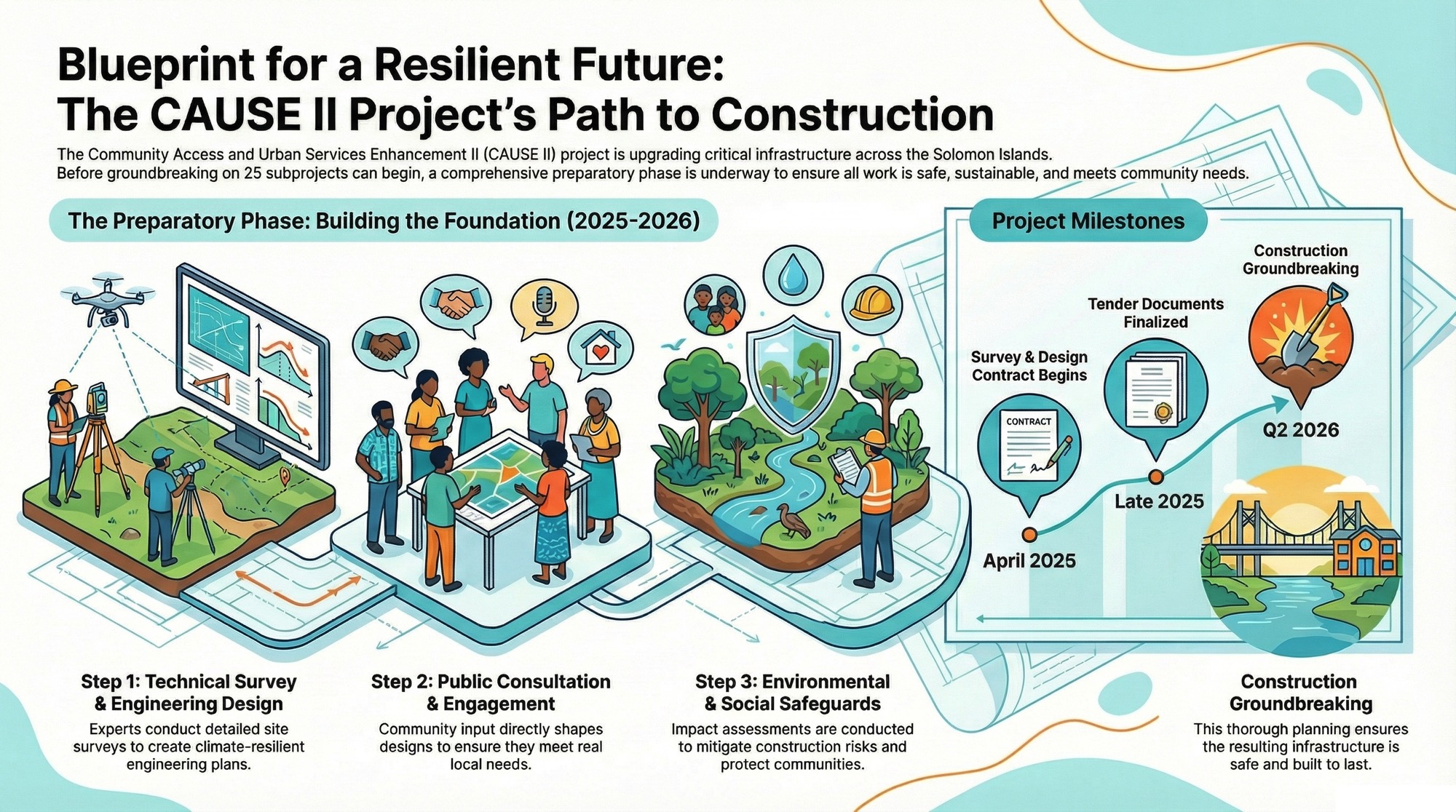
The Community Access and Urban Services Enhancement II (CAUSE II) Project has officially entered a new phase in its mission to enhance infrastructure and services in the Solomon Islands. In April 2025, a critical consultancy contract for a Survey and Design Firm was awarded to support Component 1: Resilient Township Development, marking the start of structured groundwork for the project’s 25 infrastructure subprojects. This component alone involves more than 12 kilometers of road rehabilitation, multiple bridges, drainage improvements, coastal protection upgrades, and public space developments across Honiara, Guadalcanal, Auki, and Gizo.
But before the sound of excavators hits the ground, months of preparatory work are underway and essential.
The Backbone: Survey and Design Work
The awarded firm, contracted from April 2025 to March 2026, is tasked with detailed preparatory studies. This includes topographical and geotechnical surveys, engineering design, environmental assessments, and community consultations. These activities serve as the foundation for all physical works and are crucial to ensure quality, sustainability, and safety.
For example, to properly rehabilitate a 2.2 km stretch of road in Tasahe-Ngossi or reinforce the Kobito and Mbokona bridges, engineers need detailed site data soil conditions, traffic loads, drainage patterns, and material availability. The firm will also examine climate impacts such as flooding and erosion to integrate climate-resilient features into every design.
This scientific and engineering rigor guarantees that project outcomes are safe, durable, and appropriate to local conditions. It also aligns with the Solomon Islands’ National Building Code and environmental standards set by both the Ministry of Infrastructure Development (MID) and the World Bank.
Public Consultation: A Cornerstone of the Process
One of the most important elements of this phase is community engagement. Public consultations are not a checkbox they are central to how CAUSE II operates.
The design firm must work with the CAUSE II Project Management Unit (PMU) and local authorities to engage residents, community leaders, and businesses to gather input. These sessions help identify local priorities, manage expectations, and ensure that the proposed designs are responsive to real needs. From drainage layouts in flood-prone neighborhoods to footpath safety features in busy urban centers, community voices shape the blueprint.
Stakeholder Engagement Plans, including those targeting vulnerable populations such as women and youth, are being developed in line with CAUSE II’s inclusive values. This ensures that infrastructure not only meets engineering standards but also supports equitable access and social wellbeing.
Environment and Safety Front and Center
The preparatory phase also involves conducting Environmental and Social Impact Assessments (ESIA) and developing Environmental and Social Management Plans (ESMPs). These documents anticipate potential construction risks such as sediment runoff or construction noise and outline measures to mitigate them.
Moreover, climate adaptation is built into the design from the start. Whether it’s installing adequate drainage to handle intensified rainfall or designing roads that resist heat and erosion, resilience is non-negotiable.
What’s Next?
With the survey and design work underway through early 2026, tender documents for civil works will be finalized by late 2025, allowing contracts to be awarded shortly thereafter. That means residents can expect groundbreaking on infrastructure works to begin in second quarter 2026.
Each of the 25 subprojects is part of a carefully phased implementation plan. Drainage and bridge works tender documents are scheduled for completion by December 2025, while road rehabilitations and coastal protections are set to roll out by April 2026. These timelines are dependent on the successful completion of the preparatory phase now in progress.
⸻
The Community Access and Urban Services Enhancement II (CAUSE II) Project is a transformative initiative aimed at improving climate-resilient infrastructure, enhancing economic inclusion, and strengthening service delivery in targeted urban centers across the Solomon Islands. Led by the Ministry of Infrastructure Development and Honiara City Council, in collaboration with the Ministry of Lands, Housing and Survey, and the Provincial Governments of Guadalcanal, Malaita, and Western Province, CAUSE II is a Government of Solomon Islands initiative. The project is supported by the World Bank and the Government of Australia through the Papua New Guinea and Pacific Islands Umbrella Facility Multi-Donor Trust Fund (PPIUF).
Gallery